
Tennessee Construction Deadlines
By: Abbie Dierbeck
If there’s one thing construction professionals learn quickly, it’s that deadlines matter. In Tennessee construction law, missing a deadline can be just as damaging as losing the dispute itself. Contractors, subcontractors, suppliers, and property owners often assume they have more time than they actually do, only to discover that an important claim has expired.
Whether you are pursuing payment through a mechanic’s lien, making a claim against a payment bond, or preparing for litigation over defective work, Tennessee law imposes strict timelines that must be followed carefully. Courts generally enforce these deadlines exactly as written, which means even a strong claim can disappear if the clock runs out.
The good news is that most deadline problems are preventable. Understanding the key timelines and tracking them early can help avoid costly mistakes and preserve valuable legal rights.
Bond Claim Deadlines
On public construction projects, mechanic’s liens typically cannot attach to public property. Because of that, payment bonds become one of the most important tools available to unpaid contractors, subcontractors, and suppliers.
In Tennessee, public projects commonly require a payment bond that guarantees eligible parties will be paid even if the prime contractor fails to make payment. But bond claims come with strict deadlines, and those deadlines can vary depending on the project and bond language.
For many public works projects, an unpaid subcontractor or supplier must provide written notice of its claim within 90 days after the last day labor or materials were furnished. See Tenn. Code Ann. § 12-4-205. Waiting too long to provide notice can completely bar recovery under the bond.
The deadline to file suit is also important. In many situations, a claimant must file a lawsuit within 6 months of the completion of the public project or the last furnishing of labor or materials. See Tenn. Code Ann. § 12-4-206. Missing that filing deadline may permanently eliminate the claim, even if the underlying nonpayment is undisputed.
Private projects can involve payment bonds too. Unlike public projects, however, private bond deadlines are often controlled directly by the bond itself. Some require notice within 30 days. Others allow 60 or 90 days. The lesson is simple: review the bond documents at the beginning of the project—not after payment problems start.
Mechanic’s Lien Deadlines
Tennessee mechanic’s lien deadlines vary depending on whether the claimant is a prime contractor or a remote contractor, such as a subcontractor or supplier.
Prime contractors automatically receive lien rights when they improve real property. See Tenn. Code Ann. § 66-11-102(a). Unlike remote contractors, prime contractors are generally not required to provide notice to the owner because the owner is already in direct contractual privity with them. A prime contractor’s lien continues for one year after the project is completed or abandoned. Tenn. Code Ann. § 66-11-106. However, to preserve priority against later purchasers or lenders, the contractor should record a Notice of Lien within 90 days of completion or abandonment. Tenn. Code Ann. § 66-11-112.
Remote contractors face stricter notice requirements. Before asserting a lien, a subcontractor or supplier must serve a Notice of Nonpayment on both the owner and prime contractor within 90 days after the last day of the month in which labor or materials were furnished. Tenn. Code Ann. § 66-11-145. Missing this deadline can eliminate lien rights entirely. Remote contractors must also provide a Notice of Lien within 90 days after project completion or abandonment. Tenn. Code Ann. § 66-11-115. Tennessee courts strictly enforce these deadlines. See Cooper v. Hunter, 569 S.W.2d 852, 854 (Tenn. Ct. App. 1978).
Even after recording a lien, the claimant must still timely file suit to enforce it. Recording alone does not preserve lien rights indefinitely. See Tenn. Code Ann. § 66-11-126.
One issue that frequently creates confusion is determining the “last date worked.” Punch-list work, warranty work, and minor return visits may not always extend lien deadlines, so maintaining accurate project records is critical.
Cure-Before-Litigation Requirements
Many Tennessee construction disputes involve notice and cure requirements before a lawsuit can be filed. These provisions are designed to give the other party an opportunity to fix the problem before litigation begins.
In residential construction defect cases, Tennessee law may require homeowners to provide written notice of alleged defects before filing suit. Contractors are then given a chance to inspect the property and potentially make repairs.
Construction contracts often include similar requirements. Standard AIA and ConsensusDocs agreements commonly require written notice of default and a reasonable opportunity to cure before termination, arbitration, or litigation may proceed. These provisions matter because failing to follow them can create serious consequences. A contractor who terminates a subcontract too quickly may face wrongful termination claims, while an owner who files suit prematurely could encounter delays or dismissal.
Another common issue is improper notice delivery. Some contracts require notice by certified mail or delivery to a specific representative. Simply sending an email may not satisfy the contract requirements.
The safest approach is to review all notice and cure provisions immediately when disputes arise—not after litigation has already started.
Statute of Limitations and Repose Issues
Tennessee construction claims are governed by both statutes of limitation and statutes of repose, and the difference matters. A statute of limitations sets the deadline for filing suit after a claim arises. Written contract claims generally carry a six-year limitations period under Tenn. Code Ann. § 28-3-109(a)(3), while negligence and property damage claims are often limited to three years under Tenn. Code Ann. § 28-3-105.
A statute of repose is stricter because it creates an absolute cutoff date regardless of when the defect is discovered. In many Tennessee construction cases, claims against contractors, architects, and engineers must be brought within four years after substantial completion of the project. Tenn. Code Ann. § 28-3-202. Although limited exceptions may apply for fraud or concealed defects, courts interpret those exceptions narrowly. See Counts Co. v. Praters, Inc., 392 S.W.3d 80, 86-87 (Tenn. Ct. App. 2012). The takeaway is simple: waiting too long can permanently eliminate otherwise valid claims.
Example Timeline: How Missing a Deadline Can Cost You
To see how quickly rights can disappear, consider the following example:
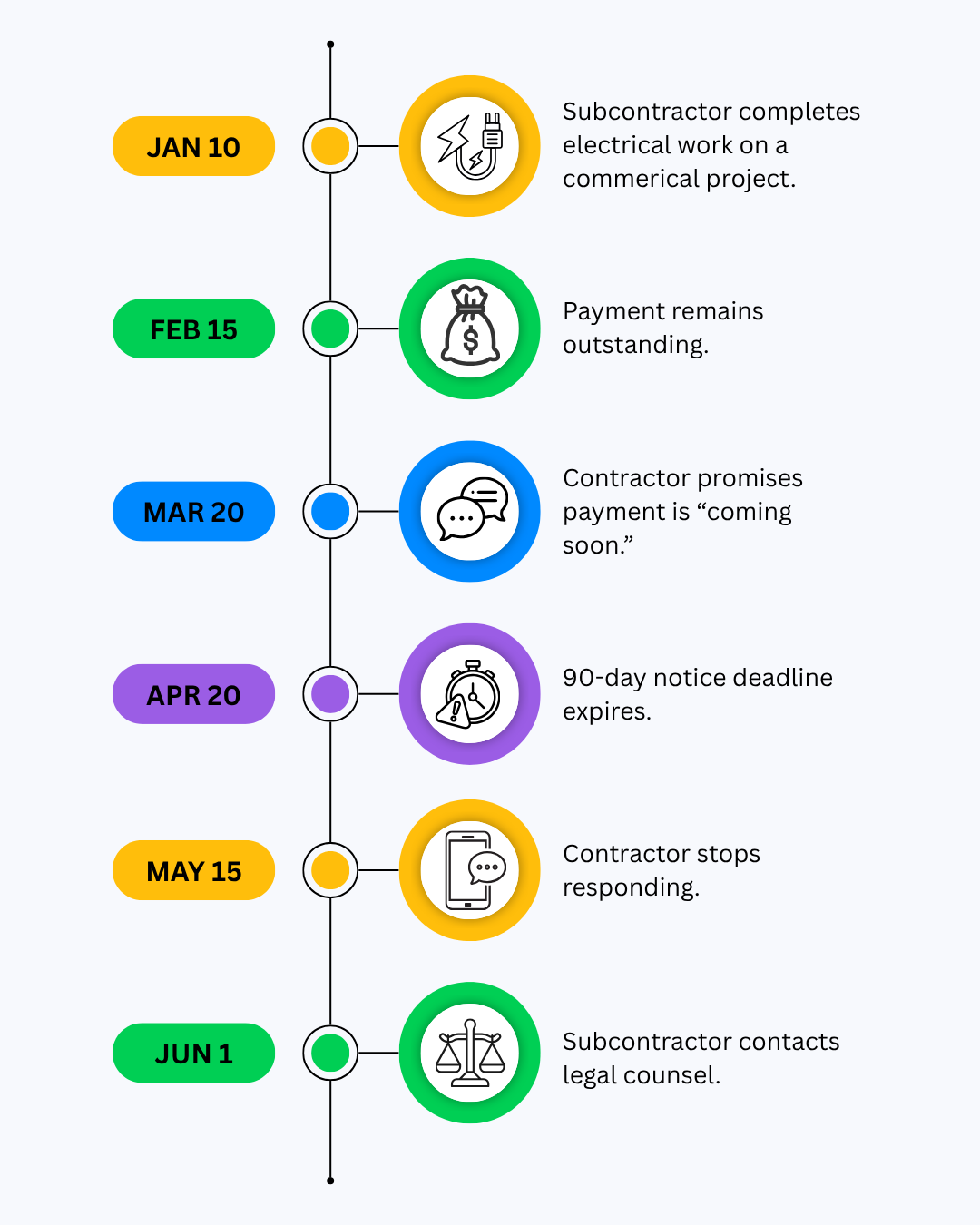
At that point, the subcontractor may have already lost its mechanic’s lien rights because the required notice deadline passed while the parties were still negotiating informally. Tennessee courts routinely enforce lien deadlines strictly, even where payment discussions are ongoing. See Tri-Am Constr., Inc. v. J & V Dev., Inc., 2006 WL 2792159 (Tenn. Ct. App. Sept. 28, 2006).
This happens more often than many contractors expect. Parties delay taking action because they hope payment issues will resolve voluntarily. Meanwhile, Tennessee’s statutory deadlines continue running in the background.
Construction Deadline Tracking Checklist
The best way to avoid losing rights is to implement a reliable deadline tracking system. Consider the following checklist:
Determine whether the project is public or private
Obtain and review all payment bond documents
Record the first and last date labor or materials were furnished
Track invoice submission and payment due dates
Calendar all lien notice deadlines immediately
Monitor recording deadlines for mechanic’s liens
Review all contract notice and cure provisions
Confirm required methods of notice delivery
Document substantial completion dates carefully
Consult legal counsel before deadlines approach
Final Thoughts
Construction deadlines in Tennessee are unforgiving, but they are manageable when tracked properly. Bond claims, mechanic’s liens, cure requirements, and statutes of limitation all impose strict timing obligations that can determine whether a claim succeeds or fails.
Understanding these rules gives contractors, subcontractors, suppliers, and property owners a major advantage. It allows parties to act early, preserve leverage, and avoid losing claims simply because too much time passed.
At the end of the day, construction disputes are stressful enough without discovering that a deadline quietly expired weeks earlier. In Tennessee construction law, staying ahead of the clock can make all the difference.